
 Image 1 of 1
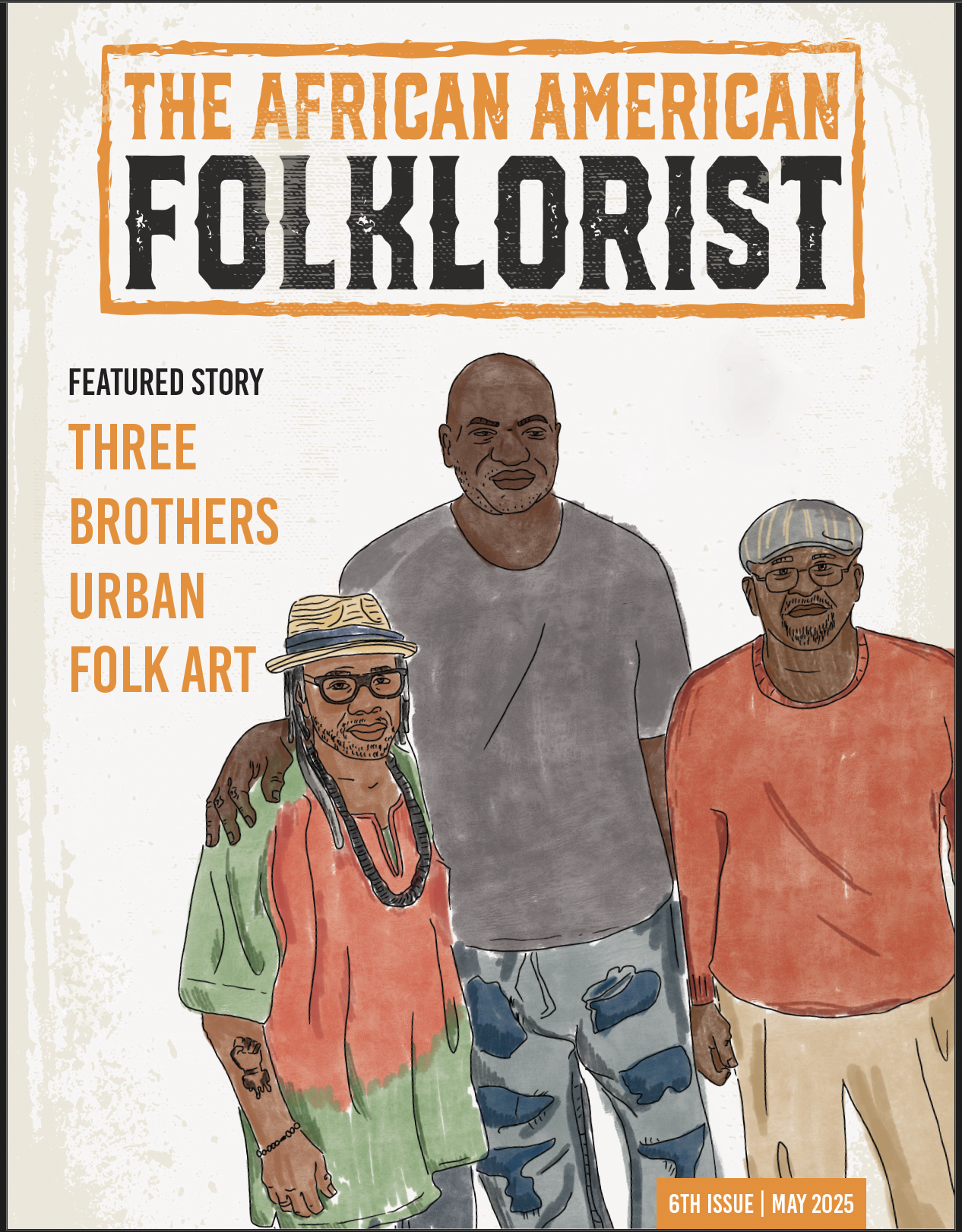
The African American Folklorist Issue 6, “Three Brothers Urban Folk Art,” centers Black folk creativity, cultural memory, and traditional artistry through its feature on Three Brothers Urban Folk Art, while also honoring the late Blues harmonica master and tradition bearer Phil Wiggins. The issue highlights lesser-known Black folk, traditional, and Blues artists, affirming their importance as cultural workers whose practices preserve memory, place, community knowledge, and Black expressive traditions.
This issue also discusses the burning of the Mississippi John Hurt Museum in Mississippi, framing the loss as more than the destruction of a building, but as an attack on Black cultural heritage, Blues memory, and community-rooted historical preservation. Alongside this, Issue 6 establishes the AAF manifesto, declaring that Black American Studies, Black folklore, and ethnomusicology have always been hybrid fields grounded in literature, memory, cultural engagement, oral history, fieldwork, and lived experience.
The manifesto challenges the erasure of Black scholars, artists, and documentarians whose methods shaped folklore, ethnomusicology, anthropology, sociology, and Black cultural studies without proper credit. Through this issue, The African American Folklorist affirms its role as a Black-led platform where Black Americans can define, document, and contextualize their own communities, traditions, identities, and cultural expressions. Centered in the voice of the Blues People, Issue 6 presents Black folklore, folk art, and the Blues as breathing archives of Black life, survival, memory, and cultural authority.
The African American Folklorist Issue 6, “Three Brothers Urban Folk Art,” centers Black folk creativity, cultural memory, and traditional artistry through its feature on Three Brothers Urban Folk Art, while also honoring the late Blues harmonica master and tradition bearer Phil Wiggins. The issue highlights lesser-known Black folk, traditional, and Blues artists, affirming their importance as cultural workers whose practices preserve memory, place, community knowledge, and Black expressive traditions.
This issue also discusses the burning of the Mississippi John Hurt Museum in Mississippi, framing the loss as more than the destruction of a building, but as an attack on Black cultural heritage, Blues memory, and community-rooted historical preservation. Alongside this, Issue 6 establishes the AAF manifesto, declaring that Black American Studies, Black folklore, and ethnomusicology have always been hybrid fields grounded in literature, memory, cultural engagement, oral history, fieldwork, and lived experience.
The manifesto challenges the erasure of Black scholars, artists, and documentarians whose methods shaped folklore, ethnomusicology, anthropology, sociology, and Black cultural studies without proper credit. Through this issue, The African American Folklorist affirms its role as a Black-led platform where Black Americans can define, document, and contextualize their own communities, traditions, identities, and cultural expressions. Centered in the voice of the Blues People, Issue 6 presents Black folklore, folk art, and the Blues as breathing archives of Black life, survival, memory, and cultural authority.